New vs Old Tax Regime for Freelancers in India: Which Saves More in 2026?
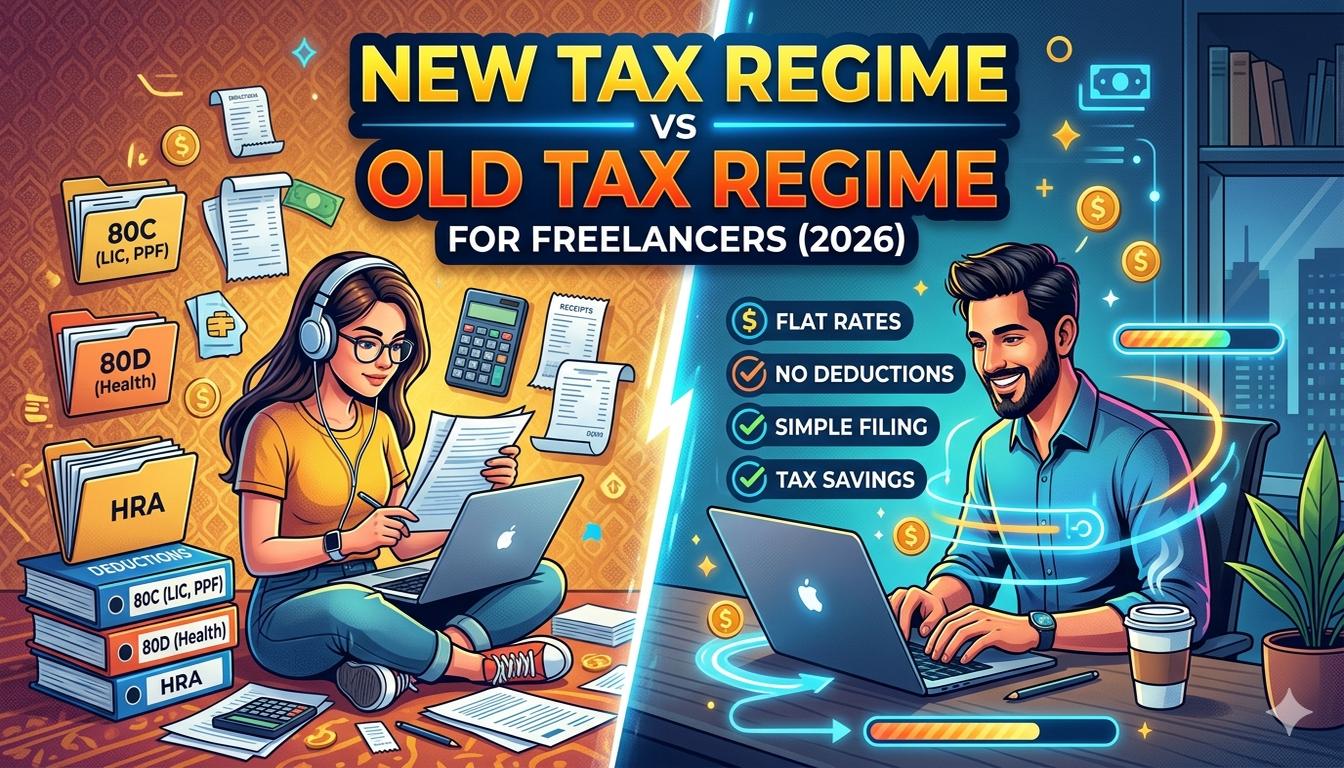
Quick Answer: For most freelancers in India, the new tax regime (FY 2025-26) is the better choice if your Chapter VI-A deductions (Section 80C, 80D, 80CCD, etc.) total less than Rs 3.75 lakh per year. The old tax regime wins only if you invest heavily in instruments like PPF, ELSS, health insurance, NPS, and have an education loan — typically saving Rs 7,000–Rs 60,000+ in tax depending on your income and deductions. Since the new regime is now the default from FY 2024-25, you must actively opt for the old regime while filing your ITR if you want the deductions. Under Section 44ADA, both regimes allow 50% deemed expense on income up to Rs 50 lakh — the difference lies entirely in which deductions you can claim on top.
New Tax Regime vs Old Tax Regime for Freelancers (2026): Which Saves More?
A freelance developer in Bengaluru earned Rs 18 lakh in FY 2025-26. Her CA filed her ITR under the old tax regime because "that is what we always do." She paid Rs 1,10,000 in tax. Had her CA compared both regimes, she would have discovered the new regime would have cost her just Rs 70,200 — a saving of nearly Rs 40,000. That is a month's rent.
Every financial year, thousands of Indian freelancers either stick with a regime out of habit or let their CA decide without understanding the math. The consequence is real money left on the table. The choice between the old tax regime and the new tax regime is not just a checkbox on your ITR form. It is a financial decision that can save or cost you anywhere from Rs 5,000 to over Rs 1,00,000 depending on your income, investments, and deductions.
Since the Union Budget 2023 made the new tax regime the default from FY 2023-24 onwards, the decision has become even more critical. You no longer default to the old regime — you have to actively choose it. And for freelancers, the calculation is different from salaried employees because your income structure, expense patterns, and eligible deductions work differently.
This guide breaks down both regimes with slab comparisons, deduction analysis, Section 44ADA implications, and worked examples with actual numbers so you can make an informed choice for FY 2025-26.
Why This Decision Matters More Than You Think
The tax regime you choose directly determines how much of your hard-earned income goes to the government and how much stays in your pocket. Here is why freelancers need to pay special attention to this decision.
- Freelancers have unique deduction patterns: Unlike salaried employees who get HRA and standard deduction, freelancers rely on Chapter VI-A deductions (80C, 80D, 80CCD) and business expense deductions. The regime you pick determines which of these you can claim
- Section 44ADA changes the equation: Under Section 44ADA, freelancers with income up to Rs 50 lakh can declare 50% as profit. This halves your taxable income BEFORE regime-based deductions apply — making the slab rates more important than you might think
- The new regime has dramatically lower slab rates: The 30% bracket kicks in only above Rs 24 lakh under the new regime, compared to Rs 10 lakh under the old regime. For freelancers earning above Rs 10 lakh, this difference alone can be massive
- You can switch every year: For most freelancers, there is no lock-in. You can choose the new regime one year and the old regime the next, picking whichever saves more tax for that specific year
Did You Know? According to the Income Tax Department, over 72% of individual taxpayers chose the new tax regime for AY 2025-26 (FY 2024-25). However, many freelancers who could have benefited from the old regime missed out because they did not compare the two before filing. Do not let that be you.
What Are the Two Tax Regimes? A Quick Overview
India has two parallel income tax systems that individual taxpayers can choose from. Both calculate your tax differently, and you must pick one when filing your ITR.
Old Tax Regime (Existing/Traditional Regime)
The old regime has been in place for decades. It features higher tax slab rates but allows you to claim a wide range of deductions and exemptions to reduce your taxable income.
Key characteristics:
- Higher slab rates (30% kicks in at Rs 10 lakh)
- Access to all Chapter VI-A deductions: 80C, 80D, 80E, 80CCD, 80G, 80EEA
- Exemptions like HRA (for salaried), LTA (leave travel allowance)
- Business expense deductions under Section 37(1) — critical for freelancers filing ITR-3
- Section 44ADA deemed expense available
New Tax Regime (Section 115BAC)
Introduced in FY 2020-21 and made the default from FY 2023-24, the new regime offers lower slab rates but significantly restricts deductions and exemptions.
Key characteristics:
- Lower slab rates (0% up to Rs 4 lakh, 30% only above Rs 24 lakh)
- Most Chapter VI-A deductions are NOT available (80C, 80D, 80E, 80CCD(1B), 80G are blocked)
- Section 44ADA is available — this is crucial for freelancers
- Standard deduction of Rs 75,000 is available (FY 2024-25 onwards) but only for salary and pension income
- Simplified structure with fewer decisions to make
Important: The new tax regime is the default regime from FY 2023-24. If you do not actively opt for the old regime while filing your ITR, the system will calculate your tax under the new regime. For salaried employees, the employer deducts tax based on the regime you select. For freelancers paying advance tax, you must calculate under your chosen regime from the start of the financial year. Read our guide on advance tax for freelancers to understand how regime choice affects your quarterly installments.
Tax Slab Comparison: Old vs New for FY 2025-26
The slab rates are the most visible difference between the two regimes. Here is the complete comparison for individuals below 60 years of age for FY 2025-26.
Income Tax Slab Rates
| Income Slab (Rs) | Old Tax Regime Rate | New Tax Regime Rate |
|---|---|---|
| 0 – 2,50,000 | 0% | 0% |
| 2,50,001 – 3,00,000 | 5% | 0% |
| 3,00,001 – 4,00,000 | 5% | 0% |
| 4,00,001 – 5,00,000 | 5% | 5% |
| 5,00,001 – 6,00,000 | 20% | 5% |
| 6,00,001 – 7,50,000 | 20% | 5% |
| 7,50,001 – 9,00,000 | 20% | 10% |
| 9,00,001 – 10,00,000 | 20% | 10% |
| 10,00,001 – 12,00,000 | 30% | 15% |
| 12,00,001 – 15,00,000 | 30% | 15% |
| 15,00,001 – 16,00,000 | 30% | 15% |
| 16,00,001 – 18,00,000 | 30% | 20% |
| 18,00,001 – 20,00,000 | 30% | 20% |
| 20,00,001 – 24,00,000 | 30% | 25% |
| Above 24,00,000 | 30% | 30% |
Rebate Under Section 87A
The rebate makes a significant difference, especially for lower-income freelancers.
| Parameter | Old Tax Regime | New Tax Regime |
|---|---|---|
| Rebate amount | Up to Rs 12,500 | Up to Rs 60,000 |
| Income eligibility | Total income up to Rs 5,00,000 | Total income up to Rs 12,00,000 |
| Effective result | Zero tax if income ≤ Rs 5L after deductions | Zero tax if income ≤ Rs 12L after deductions |
Pro Tip: Under the new regime, a freelancer with taxable income up to Rs 12 lakh pays zero tax thanks to the Section 87A rebate. Under the old regime, the zero-tax threshold is only Rs 5 lakh. This alone makes the new regime extremely attractive for freelancers earning up to Rs 25 lakh (after Section 44ADA, taxable income would be Rs 12.5 lakh — just above the rebate limit).
Surcharge and Cess
Both regimes charge the same surcharge and cess on top of the basic tax:
| Taxable Income (Rs) | Surcharge Rate |
|---|---|
| 50 lakh – 1 crore | 10% |
| 1 crore – 2 crore | 15% |
| Above 2 crore | 25% |
Health and Education Cess: 4% on tax plus surcharge, applicable under both regimes.
What Deductions Are Available Under the Old Tax Regime?
The old regime's biggest advantage is the wide range of deductions it offers. For freelancers who invest systematically, these deductions can substantially reduce taxable income.
Chapter VI-A Deductions (Most Popular)
| Section | Deduction For | Maximum Limit |
|---|---|---|
| 80C | PPF, ELSS, LIC premium, NSC, 5-year FD, tuition fees | Rs 1,50,000 per year |
| 80CCC | Pension plans from insurance companies | Rs 1,50,000 (within 80C limit) |
| 80CCD(1B) | NPS contribution (self, over and above 80C) | Rs 50,000 per year |
| 80D | Health insurance premium (self, spouse, children) | Rs 25,000 (Rs 50,000 for senior citizens) |
| 80D | Health insurance for parents | Rs 25,000 (Rs 50,000 for senior citizen parents) |
| 80E | Interest on education loan (higher studies, self) | No upper limit |
| 80G | Donations to approved charities and relief funds | 50% or 100% of donation (varies) |
| 80EEA | Home loan interest (first-time buyers, affordable housing) | Rs 50,000 per year |
| 80CCF | Infrastructure bonds | Rs 20,000 (currently not active) |
Business Expense Deductions (Under ITR-3 Only)
If you file ITR-3 (actual profit and loss) instead of Section 44ADA, you can claim actual business expenses:
- Office rent, coworking space, internet, phone bills
- Laptop depreciation (40% per year under Block of Assets)
- Software subscriptions, professional courses, books
- Travel for client meetings, conference registrations
- CA fees for tax filing and audit
- Bank charges, payment gateway fees
These deductions under Section 37(1) and Section 32 are available under the old regime. Under the new regime, they are also available if you file ITR-3.
Important: Business expense deductions (Section 37, 32) are available under BOTH regimes. The deduction difference between the two regimes is limited to Chapter VI-A deductions (80C, 80D, 80E, etc.). This is a common misunderstanding. Your internet bill, laptop, and coworking rent are deductible regardless of which regime you choose. For a complete list of 25+ deductions freelancers can claim, read our freelancer expenses list.
Maximum Total Chapter VI-A Deduction Possible
| Deduction Combination | Annual Amount |
|---|---|
| Section 80C (PPF + ELSS) | Rs 1,50,000 |
| Section 80D (self + parents) | Rs 1,00,000 |
| Section 80CCD(1B) (NPS) | Rs 50,000 |
| Section 80E (education loan interest) | No limit (varies) |
| Section 80G (donations) | Varies |
| Typical maximum | Rs 3,00,000 – Rs 3,75,000+ |
If your total Chapter VI-A deductions exceed Rs 3.75 lakh per year, the old regime will almost always save you more tax. If they are below Rs 2 lakh, the new regime's lower slab rates usually win.
What Deductions Are Available Under the New Tax Regime?
The new regime's philosophy is simple: lower tax rates but fewer deductions. Most popular exemptions and deductions are blocked. Here is what remains.
Deductions Still Available Under New Regime
| Deduction | Available? | Notes |
|---|---|---|
| Section 44ADA (50% deemed expense) | ✅ Yes | This is the biggest relief for freelancers |
| Standard deduction | ⚠️ Salary/pension only | Rs 75,000 from FY 2024-25 — does NOT apply to freelance/business income |
| Employer's NPS (80CCD(2)) | ⚠️ Limited | Only for employer contribution, not applicable to most freelancers |
| Section 80JJAA (new employment) | ✅ Yes | For hiring new employees — rarely relevant for individual freelancers |
| Business expenses (37, 32) | ✅ Yes | Actual expenses if filing ITR-3 — same as old regime |
| Section 80C, 80D, 80E, 80CCD(1B), 80G, 80EEA | ❌ No | All blocked under new regime |
| HRA, LTA, home loan exemption | ❌ No | All blocked (not relevant for most freelancers anyway) |
What This Means for Freelancers
The new regime effectively says to freelancers: "We will give you lower slab rates, but you cannot claim deductions for insurance, investments, or donations."
For a freelancer with no significant Chapter VI-A investments, the new regime is almost always better because the lower slab rates outweigh the lost deductions.
For a freelancer who actively invests in PPF, ELSS, health insurance, and NPS, the old regime can still be more beneficial — but only if the total deductions are large enough to compensate for the higher slab rates.
Pro Tip: The new regime is ideal for freelancers who want a simple, low-hassle tax life. No need to maintain PPF accounts, track insurance premiums, or manage ELSS lock-in periods. Your tax is calculated at lower slab rates on a clean income figure. For freelancers just starting out or those who prefer investing independently rather than through tax-saving instruments, the new regime is the clear winner. Track your income and estimate your tax under both regimes using the free tools on FreelanceBook.
How Section 44ADA Interacts with Both Regimes
Section 44ADA is the presumptive taxation scheme for professionals, including freelancers. It allows you to declare 50% of your gross receipts as income (the other 50% is deemed as expenses). This section is available under BOTH tax regimes and works the same way in each.
Section 44ADA Mechanics Under Both Regimes
| Feature | Old Regime | New Regime |
|---|---|---|
| 50% deemed expense | ✅ Available | ✅ Available |
| Income threshold | Up to Rs 50 lakh | Up to Rs 50 lakh |
| Chapter VI-A on top | ✅ Yes (80C, 80D, etc.) | ❌ No |
| Business expenses beyond 50% | ❌ No (if opting 44ADA) | ❌ No (if opting 44ADA) |
| ITR form | ITR-4 (Sugam) | ITR-4 (Sugam) |
| Tax audit | Not required | Not required |
How the Math Works Under Each Regime
Consider a freelancer with Rs 15 lakh in gross receipts:
Old Regime with Section 44ADA:
- Gross receipts: Rs 15,00,000
- Deemed profit (50%): Rs 7,50,000
- Less Section 80C: Rs 1,50,000
- Less Section 80D: Rs 25,000
- Less Section 80CCD(1B): Rs 50,000
- Taxable income: Rs 4,75,000
- Tax calculation with 87A rebate: Rs 0 (income below Rs 5L)
New Regime with Section 44ADA:
- Gross receipts: Rs 15,00,000
- Deemed profit (50%): Rs 7,50,000
- No Chapter VI-A deductions
- Taxable income: Rs 7,50,000
- Tax: 0-4L = Nil; 4-7.5L = 5% of 3.5L = Rs 17,500
- Cess 4%: Rs 700
- Total: Rs 18,200
Winner: Old regime — because Rs 2.25 lakh in deductions pulls the taxable income below Rs 5 lakh, triggering the Section 87A rebate and making the tax zero. The new regime, despite its lower slab rates, cannot match this because it cannot use those deductions.
Real Example: Vikram, a freelance data scientist in Gurugram, earns Rs 20 lakh per year. He invests Rs 1.5 lakh in PPF, pays Rs 25,000 in health insurance, and contributes Rs 50,000 to NPS. Under Section 44ADA, his taxable income before deductions is Rs 10 lakh. With the old regime and deductions, his taxable income drops to Rs 7.75 lakh, attracting tax of Rs 49,000 plus cess. Under the new regime (no deductions), his tax on Rs 10 lakh is Rs 40,000 plus cess. The new regime saves him roughly Rs 9,700. If Vikram had no investments at all, the new regime would save him even more — nearly Rs 55,000 compared to the old regime with no deductions.
When Section 44ADA Makes the Old Regime Win
Section 44ADA creates an interesting dynamic. Since it halves your taxable income to begin with, your remaining income might fall into a low bracket where old-regime deductions can push it to zero. This is why:
- Income up to Rs 10 lakh (Rs 5 lakh after 44ADA): Old regime often wins if you have even Rs 50,000+ in Chapter VI-A deductions, because the 87A rebate can wipe out your entire tax
- Income Rs 10-20 lakh (Rs 5-10 lakh after 44ADA): It depends on your deduction level. Moderate deductions (Rs 1.5-2.5 lakh) may or may not overcome the slab advantage
- Income above Rs 20 lakh (Rs 10+ lakh after 44ADA): New regime increasingly wins because the 20% and 30% brackets under old regime are brutal compared to the 10-15% brackets under new regime
Worked Examples: Old vs New Tax Regime for Real Freelancers
Let us put the theory to the test with four realistic freelancer profiles. All examples use Section 44ADA (50% deemed expense) for simplicity and assume the freelancer is below 60 years of age with no other income sources.
Example 1: Kavita — Content Writer, Rs 15 Lakh, Minimal Deductions
Profile: Kavita is a freelance content writer in Mumbai with Rs 15 lakh in gross receipts. She has only Rs 1.5 lakh in Section 80C deductions (PPF contributions) and no other Chapter VI-A investments.
| Parameter | Old Regime | New Regime |
|---|---|---|
| Gross receipts | Rs 15,00,000 | Rs 15,00,000 |
| Section 44ADA (50%) | Rs 7,50,000 | Rs 7,50,000 |
| Less 80C | Rs 1,50,000 | Not available |
| Taxable income | Rs 6,00,000 | Rs 7,50,000 |
| Tax on 0-2.5L | Nil | Nil |
| Tax on 2.5-5L (5%) | Rs 12,500 | Nil |
| Tax on 5-6L (20%) | Rs 20,000 | Nil |
| Tax on 4-7.5L (5%) | — | Rs 17,500 |
| Basic tax | Rs 32,500 | Rs 17,500 |
| Cess (4%) | Rs 1,300 | Rs 700 |
| Total tax | Rs 33,800 | Rs 18,200 |
Winner: New Regime — saves Rs 15,600. Kavita's single deduction of Rs 1.5 lakh under 80C is not enough to overcome the 20% bracket under the old regime. The new regime's 5% rate on her entire taxable income is far cheaper.
Example 2: Deepak — UX Designer, Rs 18 Lakh, High Deductions
Profile: Deepak is a freelance UX designer in Pune earning Rs 18 lakh. He actively invests: Rs 1.5 lakh (80C), Rs 75,000 (80D for self and parents), Rs 50,000 (NPS), and pays Rs 75,000 in education loan interest (80E).
| Parameter | Old Regime | New Regime |
|---|---|---|
| Gross receipts | Rs 18,00,000 | Rs 18,00,000 |
| Section 44ADA (50%) | Rs 9,00,000 | Rs 9,00,000 |
| Less deductions | Rs 3,50,000 | Not available |
| Taxable income | Rs 5,50,000 | Rs 9,00,000 |
| Tax on 0-2.5L | Nil | Nil |
| Tax on 2.5-5L (5%) | Rs 12,500 | Nil |
| Tax on 5-5.5L (20%) | Rs 10,000 | Nil |
| Tax on 4-8L (5%) | — | Rs 20,000 |
| Tax on 8-9L (10%) | — | Rs 10,000 |
| Basic tax | Rs 22,500 | Rs 30,000 |
| Cess (4%) | Rs 900 | Rs 1,200 |
| Total tax | Rs 23,400 | Rs 31,200 |
Winner: Old Regime — saves Rs 7,800. Deepak's Rs 3.5 lakh in deductions pushes his taxable income down to Rs 5.5 lakh, keeping most of it in the 5% bracket. Under the new regime, Rs 9 lakh faces both 5% and 10% rates without any deduction relief.
Example 3: Neha — Software Consultant, Rs 25 Lakh, Moderate Deductions
Profile: Neha is a freelance software consultant in Hyderabad billing Rs 25 lakh per year. She claims Rs 1.5 lakh (80C) and Rs 50,000 (80D for self and parents).
| Parameter | Old Regime | New Regime |
|---|---|---|
| Gross receipts | Rs 25,00,000 | Rs 25,00,000 |
| Section 44ADA (50%) | Rs 12,50,000 | Rs 12,50,000 |
| Less deductions | Rs 2,00,000 | Not available |
| Taxable income | Rs 10,50,000 | Rs 12,50,000 |
| Tax on 0-2.5L | Nil | Nil |
| Tax on 2.5-5L (5%) | Rs 12,500 | Nil |
| Tax on 5-10L (20%) | Rs 1,00,000 | Nil |
| Tax on 10-10.5L (30%) | Rs 15,000 | Nil |
| Tax on 4-8L (5%) | — | Rs 20,000 |
| Tax on 8-12L (10%) | — | Rs 40,000 |
| Tax on 12-12.5L (15%) | — | Rs 7,500 |
| Basic tax | Rs 1,27,500 | Rs 67,500 |
| Cess (4%) | Rs 5,100 | Rs 2,700 |
| Total tax | Rs 1,32,600 | Rs 70,200 |
Winner: New Regime — saves Rs 62,400. Neha's Rs 2 lakh in deductions barely makes a dent against the old regime's 20% and 30% brackets. The new regime keeps her in 5-15% territory, resulting in massive savings. At this income level, you would need over Rs 5 lakh in deductions for the old regime to compete.
Example 4: Sunita — Graphic Designer, Rs 8 Lakh, Good Deductions
Profile: Sunita is a freelance graphic designer in Jaipur earning Rs 8 lakh. She claims Rs 1.5 lakh (80C) and Rs 25,000 (80D).
| Parameter | Old Regime | New Regime |
|---|---|---|
| Gross receipts | Rs 8,00,000 | Rs 8,00,000 |
| Section 44ADA (50%) | Rs 4,00,000 | Rs 4,00,000 |
| Less deductions | Rs 1,75,000 | Not available |
| Taxable income | Rs 2,25,000 | Rs 4,00,000 |
| Tax | Nil (below basic exemption) | Nil (below Rs 4L slab) |
| Total tax | Rs 0 | Rs 0 |
Winner: Tie — both result in zero tax. Sunita's income after 44ADA (Rs 4 lakh) is low enough that both regimes produce zero tax. The old regime benefits from deductions pulling income below Rs 2.5 lakh, while the new regime's 0% slab up to Rs 4 lakh does the same.
Key Insight: As a general pattern, the new regime wins at higher incomes (Rs 15 lakh+) because the slab rate difference compounds. The old regime wins at moderate incomes (Rs 8-15 lakh after 44ADA) when you have significant Chapter VI-A deductions. At very low incomes (below Rs 5 lakh after 44ADA), both regimes often result in zero or near-zero tax.
Decision Framework: How to Choose the Right Regime
Instead of guessing, use this framework to make a data-driven decision for your specific situation.
Step 1: Calculate Your Taxable Income Under Section 44ADA
Take your gross freelance receipts and apply the 50% deemed expense:
| Gross Annual Receipts | Taxable Income (44ADA) |
|---|---|
| Rs 5,00,000 | Rs 2,50,000 |
| Rs 8,00,000 | Rs 4,00,000 |
| Rs 10,00,000 | Rs 5,00,000 |
| Rs 12,00,000 | Rs 6,00,000 |
| Rs 15,00,000 | Rs 7,50,000 |
| Rs 20,00,000 | Rs 10,00,000 |
| Rs 25,00,000 | Rs 12,50,000 |
| Rs 30,00,000 | Rs 15,00,000 |
Step 2: List Your Annual Chapter VI-A Deductions
Add up everything you invest or pay under these sections:
- Section 80C: PPF, ELSS, LIC, NSC, 5-year FD, children's tuition fees — up to Rs 1.5 lakh
- Section 80D: Health insurance for self, family, parents — up to Rs 1 lakh
- Section 80CCD(1B): NPS self-contribution — up to Rs 50,000
- Section 80E: Education loan interest — no limit
- Section 80G: Charitable donations — varies
- Section 80EEA: First-time home loan interest — up to Rs 50,000
Step 3: Use the Quick Decision Matrix
Based on your taxable income (after 44ADA) and total deductions:
| Taxable Income (after 44ADA) | Deductions < Rs 1.5L | Deductions Rs 1.5-3L | Deductions > Rs 3L |
|---|---|---|---|
| Up to Rs 4 lakh | New (zero tax) | Old (zero tax) | Old (zero tax) |
| Rs 4-6 lakh | New regime | Compare both | Old regime |
| Rs 6-10 lakh | New regime | New regime likely | Compare both |
| Rs 10-15 lakh | New regime | New regime | New regime likely |
| Above Rs 15 lakh | New regime | New regime | New regime |
Rule of Thumb: If your total Chapter VI-A deductions exceed Rs 3.75 lakh per year, go with the old regime. If they are below Rs 2 lakh, go with the new regime. In between, do the exact calculation — the difference is usually Rs 2,000-10,000 and can go either way.
Switching Between Regimes: Rules Freelancers Must Know
One of the most frequently asked questions is: "Can I switch between the old and new tax regimes every year?" The answer depends on your income type and the financial year.
Switching Rules for FY 2025-26
For most freelancers, switching is flexible:
- With only business/professional income: You can choose either regime every year while filing your ITR. There is no restriction on switching back and forth
- With salary income (moonlighting): If you have both salary and freelance income, the switching rules follow the salary income rules. You can switch every year as of FY 2024-25
- The default is new regime: If you forget to opt for the old regime, your ITR is automatically processed under the new regime
How to Opt for the Old Regime While Filing ITR
When you file your ITR on the Income Tax portal:
- Log in and start your ITR filing (ITR-3 or ITR-4)
- In the "Tax Regime" section, select "Old Tax Regime" if you want to claim Chapter VI-A deductions
- The system will allow you to claim deductions under 80C, 80D, etc.
- If you select the new regime, these fields will be greyed out
Important for advance tax payers: If you are paying quarterly advance tax (which is mandatory if your tax liability exceeds Rs 10,000 in a year), calculate your installments based on the regime you plan to choose. Switching regimes at the end of the year after paying advance tax under the wrong regime can lead to interest under Section 234C. Use our advance tax guide for freelancers to calculate your installments correctly under both regimes.
Key Deadline to Remember
- The tax regime selection is made at the time of filing your ITR
- The due date for ITR filing (without audit) is 31 July of the assessment year
- For freelancers requiring a tax audit, the due date is 31 October of the assessment year
Common Mistakes Freelancers Make When Choosing a Tax Regime
1. Blindly Following the CA's Recommendation
Many CAs default to the old regime because that is what they have used for years. While a good CA will compare both, not all do. Always ask your CA: "How much tax would I pay under each regime?" and demand to see the calculation for both.
2. Assuming Higher Deductions Always Mean Old Regime Wins
Having deductions does not automatically make the old regime better. The old regime's 20% bracket (above Rs 5 lakh) and 30% bracket (above Rs 10 lakh) are so punishing that even Rs 2-3 lakh in deductions may not compensate. Always run the actual numbers.
3. Not Considering Future Investment Plans
If you plan to start investing in PPF, ELSS, or NPS in the coming year, factor that into your regime choice. If your deductions will increase next year, the old regime might become better. Plan for the full year, not just what you have already invested.
4. Forgetting the Section 87A Rebate Under New Regime
Under the new regime, taxable income up to Rs 12 lakh attracts zero tax (thanks to the Rs 60,000 rebate). Many freelancers with income around Rs 20-24 lakh do not realize that after Section 44ADA, their taxable income could fall within this zero-tax zone.
5. Mixing Up Business Expenses with Chapter VI-A Deductions
Business expenses (internet, laptop, coworking rent) are available under BOTH regimes. Only Chapter VI-A deductions (80C, 80D, 80E) are blocked under the new regime. Do not factor business expenses into your regime comparison — they cancel out.
Pro Tip: Use FreelanceBook to track your business expenses and Chapter VI-A investments in one place. At tax time, the tool generates a clean report showing your exact taxable income under both regimes, making it easy to compare and choose. It also tracks your advance tax installments so you never miss a quarterly deadline.
Frequently Asked Questions
Which Tax Regime Is Better for Freelancers Earning Under Rs 10 Lakh?
For freelancers earning under Rs 10 lakh, the new regime is usually better unless you have significant Chapter VI-A deductions exceeding Rs 1.5 lakh per year. After Section 44ADA (50% deemed expense), your taxable income drops to Rs 5 lakh or below. Under the new regime, income up to Rs 4 lakh is completely tax-free, and Rs 4-5 lakh is taxed at just 5%. The old regime charges 5% above Rs 2.5 lakh, so with even moderate deductions, both regimes may result in zero or near-zero tax.
Can Freelancers Claim Section 80C and 80D Under the New Tax Regime?
No, Section 80C (up to Rs 1.5 lakh for PPF, ELSS, LIC) and Section 80D (health insurance premiums) are NOT available under the new tax regime for FY 2025-26. These deductions are only available if you actively opt for the old tax regime while filing your ITR. However, business expense deductions under Section 37(1) and Section 44ADA's 50% deemed expense are available under both regimes regardless of your choice.
Is the New Tax Regime Default for Freelancers in FY 2025-26?
Yes, the new tax regime is the default for all individual taxpayers from FY 2023-24 onwards, including freelancers. If you do not actively opt for the old regime while filing your ITR, the Income Tax Department will calculate your tax under the new regime. To claim Chapter VI-A deductions like Section 80C and 80D, you must explicitly select the old regime in your ITR form.
Can I Switch Between Old and New Tax Regime Every Year?
Yes, for most freelancers with only business or professional income, there is no restriction on switching between the old and new tax regimes every year. You can choose a different regime each financial year based on which one saves you more tax. The regime selection is made at the time of filing your ITR, and you are free to change it the following year without any penalty or lock-in period.
Does Section 44ADA Work Differently Under the Two Tax Regimes?
No, Section 44ADA works identically under both tax regimes. The 50% deemed expense on gross receipts up to Rs 50 lakh, the ITR-4 filing requirement, and the exemption from tax audit are the same regardless of which regime you choose. The only difference is that under the old regime, you can claim Chapter VI-A deductions (80C, 80D, 80CCD, 80E) on top of the 44ADA deemed income. Under the new regime, these additional deductions are not available.
What Is the Section 87A Rebate and How Does It Affect My Tax?
Under the old tax regime, Section 87A provides a rebate of up to Rs 12,500 if your total taxable income is Rs 5 lakh or below — effectively making your tax zero. Under the new tax regime, the rebate is up to Rs 60,000 if your taxable income is Rs 12 lakh or below. This means under the new regime, a freelancer with taxable income up to Rs 12 lakh (which corresponds to gross receipts of up to Rs 24 lakh under Section 44ADA) pays absolutely no income tax.
Should I Choose the Old Regime If I Have a Home Loan?
If you have a home loan, the deduction available depends on the type. Under Section 24(b), interest on home loan up to Rs 2 lakh is deductible from rental income or business income — and this deduction is available under BOTH regimes. However, Section 80EEA (Rs 50,000 additional deduction for first-time home buyers) is only available under the old regime. For most freelancers with a home loan, the difference is marginal unless you qualify for Section 80EEA. Always calculate the exact tax under both regimes before deciding.
Next Steps
Now that you understand the difference between both tax regimes, the next step is to run the numbers for your specific situation. Start by listing your gross freelance income and every Chapter VI-A deduction you plan to claim this year. Then compare the tax under both regimes using the slab tables and examples in this guide. If the math feels overwhelming, use the free tax regime comparison tool on FreelanceBook to get an instant answer. For a broader look at tax-saving strategies beyond regime selection, check out our guide on 10 tax saving tips for freelancers in India.