ITR-3 vs ITR-4 for Freelancers: Which One Should You File in 2026?
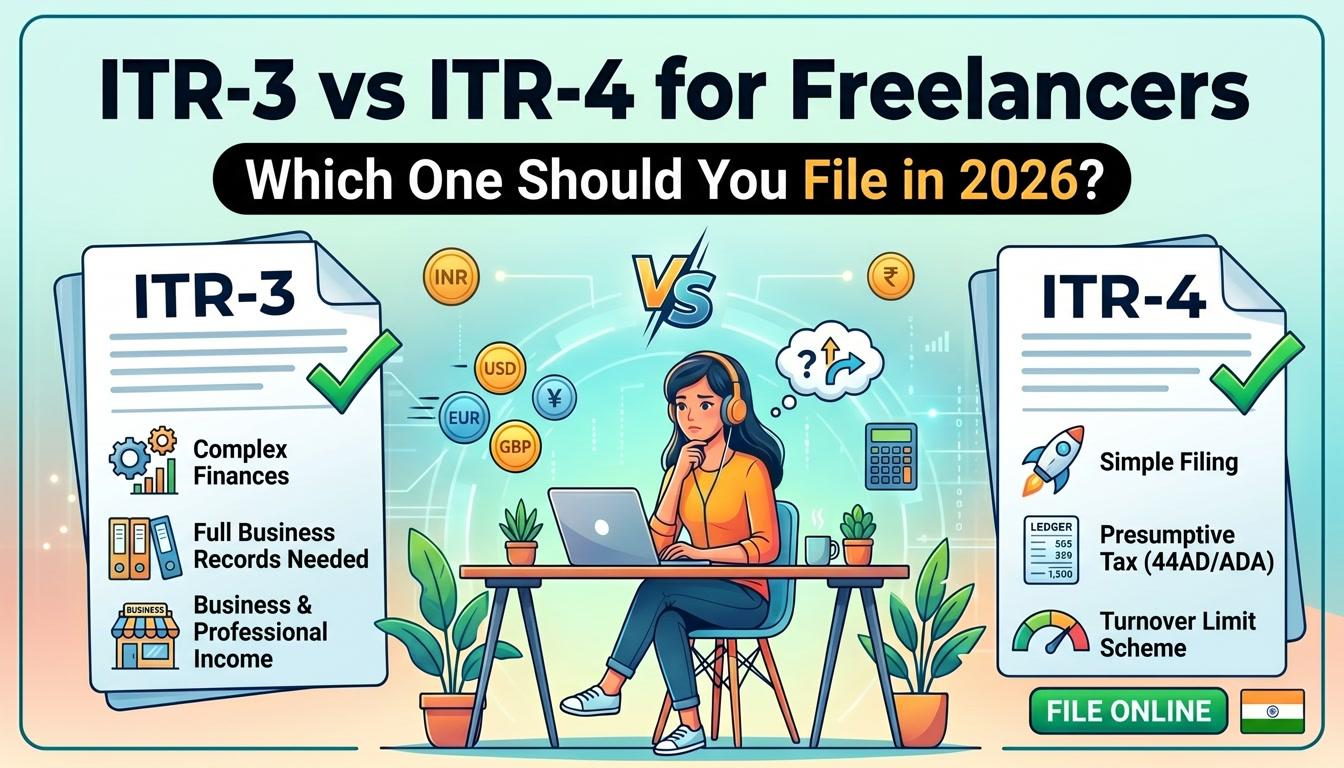
Quick Answer: Most freelancers in India should file ITR-4 (Sugam) if their gross receipts are up to Rs 75 lakh and they want to use presumptive taxation under Section 44ADA, which lets them declare 50% of income as profit without maintaining detailed accounts. Choose ITR-3 if your freelance income exceeds Rs 75 lakh, you want to claim actual expenses (instead of the 50% presumptive rate), or you have income from multiple businesses. Both forms are filed for AY 2026-27 covering income earned during FY 2025-26.
ITR-3 vs ITR-4 for Freelancers: Which One Should You File in 2026?
You have done the hard work. You earned Rs 8 lakh from freelancing in FY 2025-26, claimed your deductions, and now you are staring at the Income Tax portal wondering: "Which ITR form do I select? ITR-3 or ITR-4?" Pick the wrong one, and your return could get rejected. Pick the right one, and you save hours of paperwork.
This is the exact dilemma hundreds of thousands of Indian freelancers face every year. The Income Tax Department offers multiple ITR forms, but for freelancers and self-employed professionals, the choice usually comes down to ITR-3 and ITR-4. The form you pick depends on one key question: Do you want to use presumptive taxation (simple) or show actual profits and expenses (detailed)?
According to the CBDT (Central Board of Direct Taxes), choosing the wrong ITR form is one of the top reasons for returns getting processed with defects or notices. So getting this decision right is not just a formality. It directly affects how you report your income, what deductions you can claim, and whether you need an audit.
In this guide, we will break down both forms in simple language, show you exactly which one fits your situation, and walk you through the filing process. By the end, you will know with 100% certainty which form to file.
What Are ITR-3 and ITR-4? A Quick Overview
Before diving into the details, here is a one-glance comparison to set the stage.
| Feature | ITR-4 (Sugam) | ITR-3 |
|---|---|---|
| Full Name | ITR-4 Sugam (Presumptive Taxation) | ITR-3 (Income from Business/Profession) |
| Best For | Freelancers using Section 44ADA | Freelancers showing actual income and expenses |
| Income Limit | Gross receipts up to Rs 75 lakh | No upper limit |
| Accounts Required | No detailed books needed | Proper books of accounts required |
| Audit Required | No (under Rs 75 lakh) | Yes, if income exceeds basic exemption |
| Profit Declaration | 50% of gross receipts (or actual, if lower) | Actual profit after deducting expenses |
| Filing Complexity | Simple and quick | More detailed and time-consuming |
| Who Uses It Most | Freelancers, consultants, small professionals | Higher-income freelancers, business owners |
Did You Know? The names "Sugam" (Hindi for easy) and "Sahaj" (Hindi for simple) were given by the Income Tax Department to indicate that these forms are designed for hassle-free filing. ITR-4 (Sugam) is meant for people who want a simple filing experience without maintaining detailed accounts.
What Is ITR-4 (Sugam) and Who Is It For?
ITR-4 (Sugam) is the income tax return form designed for individuals and HUFs who have income from a business or profession and want to opt for the presumptive taxation scheme under Section 44AD (for businesses) or Section 44ADA (for professionals).
What Is Presumptive Taxation Under Section 44ADA?
Presumptive taxation is a simplified tax scheme where the government assumes a fixed percentage of your gross receipts as your profit, regardless of your actual expenses. For freelancers and professionals (doctors, lawyers, architects, accountants, engineers, consultants, and other specified professions), Section 44ADA allows you to declare 50% of your gross receipts as your taxable profit.
This means if you earned Rs 10 lakh from freelancing in FY 2025-26, you only pay tax on Rs 5 lakh (50%). The other 50% is treated as your expenses, and you do not need to show any bills or receipts to prove it.
Who is eligible for ITR-4 under Section 44ADA?
- Freelancers and professionals with gross receipts up to Rs 75 lakh per year (increased from Rs 50 lakh in Budget 2024)
- Residents of India (non-residents cannot use presumptive taxation)
- Individuals and HUFs (companies, LLPs, and firms must file ITR-5 or ITR-6)
What are the advantages of filing ITR-4?
- No books of accounts: You do not need to maintain a profit and loss statement, balance sheet, or detailed expense records
- No audit required: Under Section 44ADA, if your income is below the basic exemption limit, you do not even need to maintain basic books
- Faster filing: The form has fewer schedules and takes significantly less time to fill
- Cash flow friendly: You only pay tax on 50% of your income, which is often much lower than your actual profit margin
Who Cannot File ITR-4?
There are some situations where ITR-4 is not the right form, even if you are a freelancer:
- Your gross receipts exceed Rs 75 lakh in a financial year
- You have income from more than one business or profession (unless all qualify under presumptive taxation)
- You want to declare income lower than 50% of gross receipts AND you do not want to get your accounts audited
- You have capital gains from shares, mutual funds, or property (ITR-4 does not support detailed capital gains reporting)
- You are a non-resident Indian
- You are a director in a company or have invested in unlisted equity shares
Pro Tip: If your freelance income is below Rs 75 lakh and you do not have complicated investments, ITR-4 is almost always the better choice. It saves you from the headache of maintaining detailed accounts and potentially getting an audit done. Only switch to ITR-3 if you have a genuine reason, like wanting to claim expenses higher than 50% of your income.
What Is ITR-3 and Who Is It For?
ITR-3 is the income tax return form for individuals and HUFs who earn income from a business or profession and do not opt for (or are not eligible for) the presumptive taxation scheme. It is the most comprehensive form for business and professional income.
When Should You File ITR-3?
You should choose ITR-3 over ITR-4 in these situations:
- Your gross receipts exceed Rs 75 lakh: Section 44ADA is not available above this threshold, so you must file ITR-3 with actual income and expenses
- You want to claim actual expenses higher than 50%: If your actual expenses are 60-70% of your income (like heavy software subscriptions, equipment, coworking space), showing actuals in ITR-3 can result in lower taxable income
- You have income from multiple businesses: If you run a freelance business and also have income from another business activity, ITR-3 accommodates both
- You have complex capital gains: ITR-3 supports detailed reporting of short-term and long-term capital gains from shares, mutual funds, property, and other assets
- You want to carry forward losses: If your freelance business incurred a loss and you want to carry it forward to offset future income, you must file ITR-3
- You have foreign income or assets: If you earned money from international clients or hold foreign assets, ITR-3 supports the required disclosures
What Do You Need to File ITR-3?
Filing ITR-3 is more involved than ITR-4 because you need to show actual financials:
- Profit and Loss statement: A detailed breakdown of your income and expenses for the year
- Balance sheet: Showing your assets, liabilities, and capital
- Bank account details: All bank accounts used for business transactions
- Expense receipts and bills: To substantiate every deduction you claim
- Tax audit report (if applicable): If your income exceeds the basic exemption limit and you are not under presumptive taxation, you may need a tax audit under Section 44AB
The tax audit requirement kicks in if your business income exceeds Rs 1 crore (Rs 10 crore if 95% of receipts are through digital modes). If an audit is needed, you must get your accounts audited by a Chartered Accountant (CA) before filing.
Did You Know? Before AY 2020-21, ITR-3 was known as ITR-4, and the current ITR-4 was called ITR-4S (Sugam). The Income Tax Department renumbered the forms to avoid confusion. Many old articles and YouTube videos still use the old names, which causes confusion. Always check the current form names on the official portal.
Key Differences Between ITR-3 and ITR-4 for Freelancers
Here is a detailed side-by-side comparison that covers every aspect that matters when choosing your ITR form.
Eligibility and Income Limits
| Criteria | ITR-4 (Sugam) | ITR-3 |
|---|---|---|
| Resident status | Resident individuals and HUFs only | Residents and non-residents |
| Gross receipts limit | Up to Rs 75 lakh | No limit |
| Business type | Only presumptive taxation | Regular taxation (actual income/expenses) |
| Number of businesses | One business or profession | Multiple businesses and professions |
Tax Computation Method
| Criteria | ITR-4 (Sugam) | ITR-3 |
|---|---|---|
| Profit declaration | 50% of gross receipts (deemed) | Actual profit after deducting real expenses |
| Can declare lower than 50%? | Yes, but requires audit | Already showing actuals, so no issue |
| Expense tracking needed? | No | Yes, for every deduction claimed |
| Balance sheet required? | No | Yes |
| Tax audit required? | No (unless income claimed below 50%) | Yes, if turnover exceeds threshold |
Reporting Capabilities
| Criteria | ITR-4 (Sugam) | ITR-3 |
|---|---|---|
| Salary income | Yes | Yes |
| House property income | Yes | Yes |
| Capital gains | Basic (limited schedules) | Detailed (all types) |
| Foreign income/assets | No | Yes |
| Director in a company | No | Yes |
| Unlisted shares | No | Yes |
| Presumptive income from other business | Yes (Section 44AD) | Not applicable |
Common Mistake: Some freelancers file ITR-4 while also reporting capital gains from equity mutual funds. The ITR-4 form has limited capital gains schedules. If you have significant capital gains, use ITR-3 to ensure complete and accurate reporting. Mismatched reporting can lead to notices from the Income Tax Department.
Section 44ADA: The Presumptive Taxation Rule That Simplifies Everything
Section 44ADA is the single most important provision that makes ITR-4 attractive for freelancers. Understanding it fully can save you both time and money.
How Section 44ADA Works
Under Section 44ADA, if you are a resident professional (the law specifies certain professions like legal, medical, engineering, architecture, accountancy, technical consultancy, interior decoration, and any other profession notified by the government), and your gross receipts do not exceed Rs 75 lakh, you can declare 50% of your gross receipts as your taxable income.
The remaining 50% is treated as your allowable business expenses. You do not need to prove any expenses with receipts or bills. The government assumes your expenses are at least 50% of your income.
Example: You earned Rs 6,00,000 from freelance content writing in FY 2025-26.
| Item | Amount (Rs) |
|---|---|
| Gross receipts (total freelance income) | 6,00,000 |
| Deemed profit (50% under Section 44ADA) | 3,00,000 |
| Deduction under Section 80C | 1,50,000 |
| Deduction under Section 80D | 25,000 |
| Taxable income | 1,25,000 |
| Tax under new regime | Nil (below Rs 4 lakh threshold) |
Compare this with showing actuals. If your actual expenses were only Rs 1,50,000 (internet, software, coworking space), your taxable income would be Rs 4,50,000, resulting in a tax of Rs 7,800 under the new regime. Section 44ADA saves you money here.
When Is Section 44ADA Most Beneficial?
Presumptive taxation works best when your actual expenses are close to or below 50% of your income. For most freelancers, this is the case because:
- Content writers mainly need a laptop and internet
- Designers already own their equipment
- Consultants work from home with minimal overhead
- Developers primarily use their own computers and software subscriptions
Pro Tip: Some freelancers have very high actual expenses (like renting office space, hiring assistants, or buying expensive equipment). If your expenses exceed 50% of your income, filing ITR-3 with actuals could result in lower taxable income. Run both calculations before deciding.
Declaring Lower Income Under Section 44ADA
You can declare income lower than 50% of gross receipts under Section 44ADA, but there is a catch. If your declared income is below 50% and it also exceeds the basic exemption limit (Rs 3 lakh under the new regime for FY 2025-26), you must:
- Maintain proper books of accounts as per Section 44AA
- Get a tax audit done under Section 44AB by a Chartered Accountant
This defeats the simplicity advantage of ITR-4. So if you need to declare lower than 50%, you are usually better off filing ITR-3 with full actuals.
Did You Know? The Rs 75 lakh threshold for Section 44ADA was increased from Rs 50 lakh in the Union Budget 2024. This was a big win for freelancers, as more professionals can now use the presumptive scheme without worrying about maintaining detailed accounts.
Who Should File ITR-4 (With Examples)
ITR-4 is the ideal form for the majority of freelancers in India. Here are specific scenarios where ITR-4 is the clear winner.
Scenario 1: Freelancer with Income Under Rs 75 Lakh and Minimal Expenses
Arun is a freelance web developer in Pune. He earned Rs 12,00,000 from client projects in FY 2025-26. His actual expenses (laptop depreciation, internet, web hosting, software subscriptions) were about Rs 1,80,000, which is only 15% of his income.
Under ITR-4 (Section 44ADA):
- Deemed profit: 50% of Rs 12,00,000 = Rs 6,00,000
- After Section 80C (Rs 1,50,000) and 80D (Rs 25,000)
- Taxable income: Rs 4,25,000
- Tax (new regime): Rs 1,250
Under ITR-3 (actuals):
- Actual profit: Rs 12,00,000 - Rs 1,80,000 = Rs 10,20,000
- After same deductions
- Taxable income: Rs 8,45,000
- Tax (new regime): Rs 22,500
Arun saves Rs 21,250 by filing ITR-4. The choice is obvious.
Scenario 2: Part-Time Freelancer with Salaried Income
Meera works full-time at an IT company earning Rs 8,00,000 per year and freelances on weekends earning Rs 3,00,000. Her employer already deducted TDS on her salary.
She can file ITR-4 because:
- Her freelance income (Rs 3,00,000) is well below Rs 75 lakh
- Section 44ADA applies: 50% of Rs 3,00,000 = Rs 1,50,000 deemed profit
- ITR-4 allows reporting both salary income and presumptive business income
- Total taxable income is much lower, resulting in minimal additional tax
Scenario 3: New Freelancer in Their First Year
Vikram just started freelancing in December 2025 and earned Rs 1,50,000 by March 2026. He has no prior tax filing history.
ITR-4 is perfect because:
- The filing process is simple and beginner-friendly
- No need to maintain expense records
- His deemed profit is only Rs 75,000, which is below the taxable threshold
- He files a zero-tax return to establish a filing history
Who Should File ITR-3 (With Examples)
ITR-3 becomes necessary when your financial situation is more complex. Here are the scenarios where ITR-3 is the right choice.
Scenario 1: High-Income Freelancer with Significant Expenses
Deepa runs a freelance photography business in Mumbai. Her gross receipts are Rs 90,00,000 (exceeds Rs 75 lakh threshold). Her expenses include studio rent (Rs 12,00,000), equipment purchases (Rs 15,00,000), assistant salaries (Rs 8,00,000), travel (Rs 4,00,000), and other costs (Rs 6,00,000).
She must file ITR-3 because:
- Gross receipts exceed Rs 75 lakh, making her ineligible for Section 44ADA
- Her actual expenses (Rs 45,00,000) are 50% of income, so showing actuals in ITR-3 is the only option
- She may need a tax audit since turnover exceeds Rs 1 crore
Under ITR-3:
- Actual profit: Rs 90,00,000 - Rs 45,00,000 = Rs 45,00,000
- After deductions under Section 80C, 80D, and depreciation
- Taxable income will be lower than the deemed 50% because her real expenses are high and include depreciation benefits
Scenario 2: Freelancer with Capital Gains
Karthik earns Rs 5,00,000 from freelance consulting and also sold shares worth Rs 3,00,000 in profit during the year. He also has Rs 1,00,000 long-term capital gains from equity mutual funds.
He should file ITR-3 because:
- ITR-4 has limited schedules for capital gains
- ITR-3 provides detailed schedules for short-term and long-term capital gains
- He needs to show each transaction with dates, purchase price, sale price, and type of gain
- Reporting everything accurately in ITR-3 avoids mismatch notices
Scenario 3: Freelancer Wanting to Carry Forward Business Losses
Neha started a freelance content agency in April 2025. In her first year, she spent Rs 8,00,000 on setup costs (hiring writers, marketing, tools) but earned only Rs 3,00,000. She has a business loss of Rs 5,00,000.
She must file ITR-3 because:
- ITR-4 under presumptive taxation does not allow loss carry forward (since deemed profit is always 50% of income, it can never be negative)
- Only ITR-3 allows you to declare a business loss and carry it forward to offset income in future years
- Filing on time (before the due date) is critical for loss carry forward under Section 80
Step-by-Step: How to File ITR-3 or ITR-4 Online
The filing process is similar for both forms. The main difference is in the amount of information you need to provide. Here is the complete process.
Step 1: Register or Log In on the Income Tax Portal
Go to incometax.gov.in and log in with your PAN as the user ID. If you are a first-time user, register using your PAN, Aadhaar, and mobile number.
Step 2: Select the Correct Assessment Year
For income earned in FY 2025-26 (April 2025 to March 2026), select AY 2026-27. This is the assessment year when you file the return.
Common Mistake: Selecting the wrong assessment year is one of the most frequent errors. FY 2025-26 = AY 2026-27. Always double-check before proceeding.
Step 3: Choose the ITR Form
On the dashboard, click "File Income Tax Return" and select the appropriate form:
- Choose ITR-4 (Sugam) if you are using presumptive taxation under Section 44ADA
- Choose ITR-3 if you are showing actual income and expenses
The portal will ask you a few questions (income sources, age, residency status) and may suggest a form. However, always verify the suggestion against your actual situation.
Step 4: Fill in Your Personal Details
Enter your name, PAN, date of birth, address, bank account details (for refund), and other personal information. Make sure your bank account is pre-validated on the portal for faster refund processing.
Step 5: Enter Your Income Details
For ITR-4:
- Select "Presumptive Taxation under Section 44ADA"
- Enter your gross receipts from freelancing
- The form will auto-calculate 50% as your deemed profit
- Enter salary income (if any), house property income, and other income
For ITR-3:
- Enter your gross professional income
- Fill in your expense details under the Profit and Loss schedule
- Enter depreciation on assets if applicable
- Enter your balance sheet details
- Enter salary income, house property income, capital gains, and other income
Step 6: Claim Deductions
Under both forms, claim applicable deductions:
- Section 80C: Up to Rs 1,50,000 (PPF, ELSS, LIC, tuition fees)
- Section 80D: Up to Rs 25,000 for health insurance (Rs 50,000 for senior citizens)
- Section 80E: Interest on education loan (no limit)
- Section 80G: Donations to approved charities
Pro Tip: Under the new tax regime (default from FY 2023-24), most of these deductions are not available. If you want to claim Section 80C, 80D, and other traditional deductions, you must actively opt for the old tax regime while filing. Run the numbers for both regimes before choosing.
Step 7: Enter TDS Details
Enter all TDS deducted by your clients. You can find these details in your Form 26AS and Annual Information Statement (AIS), available on the Income Tax portal. For each client, you need:
- Client's name
- Their TAN (Tax Deduction Account Number)
- Amount of TDS deducted
- Section under which TDS was deducted (usually 194J for freelancers)
Step 8: Verify Tax Computation
The portal will automatically calculate your total tax, subtract TDS and advance tax, and show your refund or tax payable. Double-check these numbers carefully.
Step 9: Submit and E-Verify
After previewing the return, submit it and e-verify within 30 days. E-verification methods include:
- Net banking (fastest and most reliable)
- Bank account ATM (debit your account with Rs 1 and reverse it)
- Aadhaar OTP
- Demat account OTP
Your return is considered filed only after successful e-verification. An unverified return is treated as invalid.
Did You Know? The due date for filing ITR for individuals (without audit) is 31 July 2026 for AY 2026-27. If you need an audit, the deadline is 31 October 2026. You can also file a belated return by 31 December 2026, but you will lose certain benefits like carrying forward losses.
What Happens If You File the Wrong ITR Form?
Filing the wrong ITR form is more common than you think, and the consequences can range from a simple notice to a returned return. Here is what you need to know.
What Makes It "Wrong"?
You have filed the wrong form if:
- You filed ITR-4 but your gross receipts exceeded Rs 75 lakh
- You filed ITR-4 but claimed capital gains that the form does not support
- You filed ITR-3 but were eligible for presumive taxation (this is not wrong per se, but unnecessarily complicated)
- You filed a form meant for salaried individuals (ITR-1) when you have freelance income
What Happens Next?
If the Income Tax Department catches the error:
- Defective return notice: You will receive a notice under Section 139(9) giving you 15 days to correct the form
- Processing delay: Your return processing and refund (if any) will be delayed until the issue is resolved
- Potential scrutiny: Repeated errors can increase your chances of being selected for scrutiny assessment
If you catch the error yourself:
- Before processing: File a revised return under Section 139(5) using the correct form. There is no penalty for filing a revised return before the ITR is processed
- After processing: You may need to file a rectification request or a revised return, depending on the assessment status
Common Mistake: Some freelancers file ITR-1 (Sahaj) thinking it is simpler. But ITR-1 is only for salaried individuals with one house property and no business income. If you have freelance income, ITR-1 is the wrong form. Your return will be treated as defective.
Common Mistakes When Choosing Between ITR-3 and ITR-4
These are the pitfalls that catch freelancers every year. Knowing about them in advance can save you time, money, and unnecessary stress.
Filing ITR-4 When Gross Receipts Exceed Rs 75 Lakh
The Rs 75 lakh threshold for Section 44ADA was increased in Budget 2024, but some freelancers still miss it. If your freelance income (before any expenses) crosses Rs 75 lakh, you cannot use ITR-4. You must file ITR-3 with actual income and expenses.
Check your gross receipts, not your profit. Even if your profit after expenses is only Rs 5 lakh, if your gross receipts are Rs 80 lakh, ITR-4 is not an option.
Not Maintaining Books for ITR-3
If you choose ITR-3, you need to back up your numbers with proper financial records. Many freelancers file ITR-3 with estimated expense figures and no documentation. If the Income Tax Department issues a scrutiny notice, you will need to produce:
- Bank statements for all business accounts
- Invoice copies for every client
- Expense receipts and bills
- A proper profit and loss statement
- A balance sheet signed by you (or by a CA if audited)
Forgetting to Declare Foreign Income
If you earned even a small amount from international clients (on Upwork, Fiverr, or direct clients in USD), you must declare it in your ITR. Under ITR-4, foreign income disclosure is limited. Under ITR-3, you can properly disclose foreign income and claim credit for taxes paid abroad under Section 90/90A and the applicable DTAA (Double Taxation Avoidance Agreement).
Not Carrying Forward Losses
If you had a bad year and your freelance business incurred a loss, you must file ITR-3 (not ITR-4) to carry forward that loss. And you must file before the due date (31 July for non-audit cases). Belated returns cannot carry forward losses under Section 80.
Pro Tip: Even if your freelance income is below the taxable limit and your tax is zero, still file your ITR on time. Filing creates a financial record that is useful for visa applications, loan approvals, and credit card applications. Plus, it prevents future disputes with the Income Tax Department.
Frequently Asked Questions
Can I switch from ITR-4 to ITR-3 in a later year?
Yes, you can switch between ITR-4 and ITR-3 every financial year. Your ITR form choice does not lock you in for future years. If your income crosses Rs 75 lakh, you switch to ITR-3. If your income drops below that threshold, you can go back to ITR-4. Just make sure the form you choose each year is correct for that specific year's income.
Which ITR form should I file if I have both salary and freelance income?
If your freelance income qualifies under Section 44ADA (up to Rs 75 lakh), file ITR-4. It allows you to report both salary income (from your employer) and presumptive business income from freelancing. If your freelance income exceeds Rs 75 lakh or you have complex capital gains, file ITR-3.
Is it mandatory to file ITR-3 if my income exceeds Rs 75 lakh?
Yes. Once your gross professional receipts exceed Rs 75 lakh in a financial year, Section 44ADA is not available, and you cannot file ITR-4 with presumptive taxation. You must file ITR-3 showing your actual income and expenses. You may also need a tax audit if your income exceeds the applicable threshold under Section 44AB.
Can I claim both Section 44ADA and Section 80C deductions?
Yes, these are separate deductions. Section 44ADA determines your business income (50% of gross receipts). Section 80C allows you to deduct up to Rs 1,50,000 for investments like PPF, ELSS, and LIC from your total income. Both can be claimed in the same return. However, Section 80C is only available under the old tax regime. Under the new tax regime (default), most of these deductions are not available.
What is the last date to file ITR-3 or ITR-4 for AY 2026-27?
For individuals without a tax audit requirement, the due date is 31 July 2026. If you need a tax audit (because your income exceeds the threshold or you declared income lower than 50% under Section 44ADA), the deadline extends to 31 October 2026. You can also file a belated return by 31 December 2026 with a penalty of up to Rs 5,000, but you lose the ability to carry forward losses.
Do freelancers need to get their accounts audited?
Most freelancers using Section 44ADA (filing ITR-4) do NOT need an audit, as long as their income is declared at 50% of gross receipts or higher. However, an audit is required if your income exceeds Rs 75 lakh, you declare income below 50% and it exceeds the basic exemption limit, or your total turnover exceeds Rs 1 crore (Rs 10 crore for digital payments). In these cases, a Chartered Accountant must audit your accounts under Section 44AB.
Can a freelancer file ITR-2 instead of ITR-3 or ITR-4?
No. ITR-2 is for individuals and HUFs who do not have income from business or profession. If you have freelance income (which is classified as income from a profession), you cannot file ITR-2. You must use either ITR-3 or ITR-4. ITR-2 is suitable for salaried individuals with capital gains, rental income, or foreign assets, but no business or professional income.
Next Steps
The fastest way to decide is to check your total freelance income for FY 2025-26. If it is under Rs 75 lakh and you do not have complex investments, file ITR-4 with Section 44ADA. If your income is higher or you need detailed expense reporting and capital gains disclosure, file ITR-3. Log in to incometax.gov.in, download your Form 26AS, and start filing. If you are also managing GST, our guide on how to create a GST invoice helps you handle both tax compliance requirements together.