Advance Tax for Freelancers in India: Due Dates, Calculator & Penalty Guide (FY 2025-26)
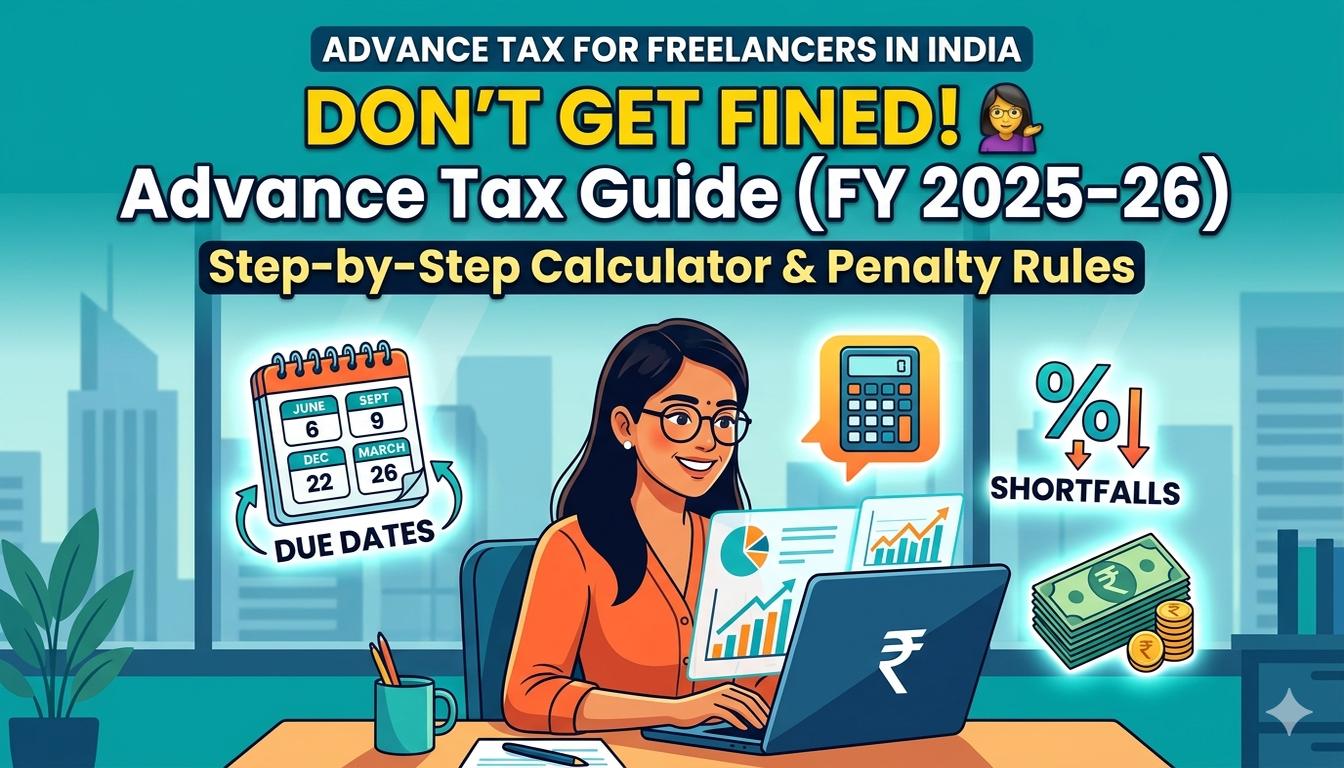
Quick Answer: Advance tax is income tax paid in quarterly installments during the financial year instead of as a lump sum at the end. If your tax liability after deducting TDS exceeds Rs 10,000 in a year, you must pay advance tax under Section 208 of the Income Tax Act. The due dates for FY 2025-26 are 15 June (15%), 15 September (45%), 15 December (75%), and 15 March (100%). Missing these dates attracts interest under Section 234C at 1% per month.
What Is Advance Tax and Why Should Freelancers Care?
So you earned Rs 12 lakh from freelancing last year, filed your ITR, and then got a notice saying you owe Rs 8,000 extra as interest. What happened? You probably missed advance tax payments. This is one of the most common tax mistakes freelancers in India make, and it is entirely avoidable.
Advance tax (also called "pay-as-you-earn" tax) is the income tax you pay in quarterly installments during the financial year itself, rather than paying everything at the end of the year. The idea is simple: the government wants you to pay tax as you earn, not as a big shocker in March.
Under Section 208 of the Income Tax Act, 1961, if your total tax liability for the year exceeds Rs 10,000 (after subtracting TDS), you are legally required to pay advance tax. For salaried employees, this is handled automatically by their employer through monthly TDS deductions. But as a freelancer, no one deducts your tax for you. You are responsible for calculating and paying it yourself.
Why does this matter for freelancers specifically?
- Freelance income is irregular: You might earn Rs 3 lakh one month and nothing the next. This makes estimating annual income tricky, but you still need to pay advance tax on time
- No employer to handle TDS: Unlike salaried professionals, freelancers must self-manage their tax payments. The CBDT (Central Board of Direct Taxes) expects you to stay on top of this
- Interest penalties add up fast: Missing even one quarterly deadline attracts interest under Section 234C at 1% per month on the shortfall. This can quickly add up to thousands of rupees
- It improves cash flow planning: Paying in smaller quarterly chunks is much easier on your wallet than one huge payment at the end of the year
Did You Know? The concept of advance tax was introduced in the Indian Income Tax Act to ensure a steady flow of revenue to the government throughout the year. For freelancers, it works like an EMI for your taxes. Instead of paying Rs 2 lakh in March, you pay Rs 30,000 in June, Rs 60,000 in September, Rs 60,000 in December, and Rs 50,000 in March.
Who Needs to Pay Advance Tax?
The rule is straightforward. Under Section 208, you must pay advance tax if your estimated tax liability for the year is more than Rs 10,000 after deducting any TDS that has already been cut.
For freelancers, this applies in most cases where annual income exceeds Rs 5-6 lakh (depending on deductions claimed under Section 80C, 80D, HRA, etc.). But the threshold is about the tax amount, not the income amount.
You need to pay advance tax if:
- Your estimated tax for the year exceeds Rs 10,000 after TDS
- You have income from sources other than salary (freelancing, business, capital gains, rent, etc.)
- You are using presumptive taxation under Section 44ADA and your tax exceeds Rs 10,000
You do NOT need to pay advance tax if:
- Your total tax for the year is below Rs 10,000 after TDS deductions
- You are a salaried employee and your employer has already deducted sufficient TDS
- You are a senior citizen (60+ years) with no business or professional income
Pro Tip: Even if your freelance income fluctuates a lot, estimate conservatively at the start of the year. You can always adjust your next quarter's payment based on actual earnings. Paying a little extra now is better than getting hit with 1% monthly interest later.
What Happens If You Don't Pay Advance Tax at All?
If your tax liability exceeds Rs 10,000 and you completely skip advance tax payments, two things happen:
First, you get hit with interest under Section 234B at 1% per month on the entire unpaid amount, starting from April of the assessment year until you pay. This is on top of the regular tax you owe.
Second, you also get charged interest under Section 234C for each quarterly installment you missed or underpaid. These two penalties stack, which means ignoring advance tax can cost you a significant amount.
Here is a real example. If your tax liability is Rs 1,20,000 and you pay nothing during the year, your penalty could look like this:
| Penalty Type | Calculation | Amount (Rs) |
|---|---|---|
| Section 234B | 1% x Rs 1,20,000 x 3 months (Apr-Jun) | 3,600 |
| Section 234C | Quarterly shortfalls (varies) | 6,000-9,000 |
| Total extra you pay | 9,600-12,600 |
That is almost Rs 10,000-13,000 wasted just because you did not plan your quarterly payments. That money could have funded a weekend trip or covered a month's groceries.
Advance Tax Due Dates for FY 2025-26 (Quarterly Schedule)
The advance tax schedule is divided into four quarters, and each quarter has a specific percentage of your total tax that must be paid by the due date. These dates are fixed by the Income Tax Department and apply uniformly across India.
Due Dates for Regular Freelancers
For most freelancers who estimate their actual income and claim deductions, the schedule is:
| Quarter | Period Covered | Due Date | % of Total Tax Payable |
|---|---|---|---|
| 1st Quarter | 1 April - 15 June | 15 June 2025 | Up to 15% of total tax |
| 2nd Quarter | 16 June - 15 September | 15 September 2025 | Up to 45% of total tax |
| 3rd Quarter | 16 September - 15 December | 15 December 2025 | Up to 75% of total tax |
| 4th Quarter | 16 December - 31 March | 15 March 2026 | 100% of total tax |
Here is how the cumulative payments work in practice. If your total estimated tax for FY 2025-26 is Rs 2,00,000:
| Due Date | Cumulative % | Amount to Pay (Rs) | Total Paid So Far (Rs) |
|---|---|---|---|
| 15 June 2025 | 15% | 30,000 | 30,000 |
| 15 September 2025 | 45% | 60,000 (45%-15%) | 90,000 |
| 15 December 2025 | 75% | 60,000 (75%-45%) | 1,50,000 |
| 15 March 2026 | 100% | 50,000 (100%-75%) | 2,00,000 |
Notice that the payment for each quarter is the difference between the current cumulative percentage and what you have already paid. You do not pay 15% in June and then another 45% in September. You pay the gap.
Common Mistake: Many freelancers think the percentages shown (15%, 45%, 75%, 100%) are the amounts for each quarter. They are not. They are cumulative. So on 15 September, you must have paid 45% of your total tax in total, not 45% as a fresh payment.
Due Dates Under Presumptive Taxation (Section 44ADA)
If you opt for presumptive taxation under Section 44ADA, the rules are more relaxed. Under this scheme, you can declare 50% of your gross receipts as your profit (regardless of actual expenses) and pay tax on that amount.
Freelancers with gross receipts up to Rs 75 lakh (increased from Rs 50 lakh in Budget 2024) can opt for Section 44ADA. If you choose this route, your advance tax schedule is simpler:
| Quarter | Due Date | % of Total Tax Payable |
|---|---|---|
| 1st Quarter | 15 June 2025 | 0% (no payment needed) |
| 2nd Quarter | 15 September 2025 | 0% (no payment needed) |
| 3rd Quarter | 15 December 2025 | 50% of total tax |
| 4th Quarter | 15 March 2026 | 100% of total tax |
This means you only pay in two installments instead of four. You pay 50% by 15 December and the remaining 50% by 15 March. This gives you more time to estimate your income accurately.
Did You Know? Under Section 44ADA, you can declare income lower than 50% of gross receipts if your actual profits are lower. But if you do that, you need to maintain proper books of accounts and get them audited. For most freelancers, the simple 50% rule is the better option.
What If the Due Date Falls on a Weekend or Holiday?
If 15 June, 15 September, 15 December, or 15 March falls on a Sunday or a public holiday, the deadline shifts to the next working day. The Income Tax Department usually announces these extensions in advance through notifications on the official portal (incometax.gov.in).
However, do not rely on extensions. Always plan to pay on or before the 15th. Sometimes the department announces extensions at the last minute, and sometimes it does not.
Pro Tip: Set recurring reminders on your phone for the 10th of every quarter (June, September, December, March). That gives you a 5-day buffer to estimate, calculate, and pay before the actual deadline.
How to Calculate Advance Tax for Freelancers (Step-by-Step)
Calculating advance tax can feel overwhelming the first time. But once you break it down, it is just basic arithmetic. Here is the step-by-step process.
Step 1: Estimate Your Total Income for the Year
This is the trickiest part for freelancers because income is unpredictable. Start by looking at what you have already earned in the current financial year and project it forward.
For example, if it is September and you have earned Rs 4 lakh from January to August, you can estimate:
- Monthly average: Rs 4 lakh / 8 months = Rs 50,000 per month
- Projected annual income: Rs 50,000 x 12 = Rs 6,00,000
Add any other income you expect during the year:
- Bank interest: Rs 15,000
- Rental income: Rs 60,000
- Capital gains (if any): Rs 20,000
Total estimated income: Rs 6,95,000
Also, subtract any TDS that has already been deducted on your income. If a client has already cut Rs 5,000 as TDS, deduct that from your total tax liability later.
Common Mistake: Many freelancers only count client payments received so far and ignore upcoming projects they have already confirmed. If you have a signed contract for a Rs 2 lakh project starting next month, include it in your estimate. The Income Tax Department expects you to pay tax on income you expect to earn, not just what you have already received.
Step 2: Subtract Deductions and Exemptions
After estimating your total income, subtract all the deductions you are eligible for. This reduces your taxable income and therefore your advance tax amount.
Common deductions for freelancers:
- Section 80C: Up to Rs 1.5 lakh (PPF, ELSS, LIC, tuition fees, home loan principal)
- Section 80D: Up to Rs 25,000 for health insurance (Rs 50,000 for senior citizens)
- Section 80E: Interest on education loan (no upper limit)
- Section 80G: Donations to approved charities (50%-100% of donation)
- Section 44ADA expenses: If using presumptive taxation, 50% of gross receipts are automatically treated as expenses. No need to show actual bills
Using our earlier example of Rs 6,95,000 total income:
| Deduction | Amount (Rs) |
|---|---|
| Section 80C (PPF + ELSS) | 1,50,000 |
| Section 80D (Health insurance) | 25,000 |
| Total deductions | 1,75,000 |
Taxable income: Rs 6,95,000 - Rs 1,75,000 = Rs 5,20,000
Pro Tip: Under Section 44ADA, you can skip showing actual expenses. The law assumes 50% of your gross receipts as profit. So if you earned Rs 6,00,000 from freelancing, your taxable profit is only Rs 3,00,000. This alone can significantly reduce your tax burden.
Step 3: Calculate Your Tax Liability
Once you know your taxable income, apply the income tax slab rates for FY 2025-26 to find your total tax.
New Tax Regime (Default) Slab Rates for FY 2025-26:
| Taxable Income (Rs) | Tax Rate |
|---|---|
| 0 - 4,00,000 | Nil |
| 4,00,001 - 8,00,000 | 5% |
| 8,00,001 - 12,00,000 | 10% |
| 12,00,001 - 16,00,000 | 15% |
| 16,00,001 - 20,00,000 | 20% |
| 20,00,001 - 24,00,000 | 25% |
| Above 24,00,000 | 30% |
Standard deduction of Rs 75,000 is available under the new regime for salaried individuals and pensioners. For freelancers using the new regime, check if this applies to your situation.
Old Tax Regime (Optional) Slab Rates for FY 2025-26:
| Taxable Income (Rs) | Tax Rate |
|---|---|
| 0 - 2,50,000 | Nil |
| 2,50,001 - 5,00,000 | 5% |
| 5,00,001 - 10,00,000 | 20% |
| Above 10,00,000 | 30% |
Did You Know? Starting from FY 2023-24, the new tax regime is the default. You need to actively opt for the old regime if you want to claim traditional deductions like HRA, LTA, and 80C. For many freelancers, the new regime with lower rates and fewer deductions can actually result in lower tax. But it depends on your specific income and expenses. Run the numbers for both regimes before deciding.
Step 4: Split Into Quarterly Installments
Now that you know your total tax liability, split it into the quarterly installments based on the cumulative percentages.
Subtract any TDS already deducted from your total tax. The remaining amount is what you need to pay as advance tax.
Total tax: Rs 1,20,000 TDS deducted by clients: Rs 15,000 Advance tax payable: Rs 1,05,000
| Due Date | Cumulative % | Amount to Pay (Rs) |
|---|---|---|
| 15 June 2025 | 15% | 15,750 |
| 15 September 2025 | 45% (30% additional) | 31,500 |
| 15 December 2025 | 75% (30% additional) | 31,500 |
| 15 March 2026 | 100% (25% additional) | 26,250 |
| Total | 1,05,000 |
Real Example: Complete Advance Tax Calculation
Let us walk through a full example with real numbers. Meet Priya, a freelance graphic designer in Mumbai.
Priya's Income Details for FY 2025-26:
- Freelance design income (estimated): Rs 9,00,000
- Bank interest: Rs 20,000
- Total income: Rs 9,20,000
Priya uses presumive taxation (Section 44ADA):
- 50% of Rs 9,00,000 = Rs 4,50,000 (deemed profit)
- Add bank interest: Rs 20,000
- Taxable income: Rs 4,70,000
Under new tax regime:
- First Rs 4,00,000: Nil
- Rs 4,00,001 to Rs 4,70,000 (Rs 70,000): 5% = Rs 3,500
- Total tax: Rs 3,500
- Add 4% Health & Education Cess: Rs 140
- Grand total: Rs 3,640
Since Priya's total tax is below Rs 10,000, she does NOT need to pay advance tax at all. She can pay the entire Rs 3,640 as self-assessment tax while filing her ITR-4.
Now consider Rahul, a freelance software developer in Bengaluru with Rs 18,00,000 income:
- Freelance income: Rs 18,00,000
- 50% deemed profit (Section 44ADA): Rs 9,00,000
- Section 80C deduction: Rs 1,50,000
- Taxable income: Rs 7,50,000
Under the new tax regime:
- First Rs 4,00,000: Nil
- Rs 4,00,001 to Rs 7,50,000 (Rs 3,50,000 at 5%): Rs 17,500
- Add 4% cess: Rs 700
- Total tax: Rs 18,200
- TDS deducted by clients: Rs 5,000
- Advance tax payable: Rs 13,200
| Due Date | Cumulative % | Amount to Pay (Rs) |
|---|---|---|
| 15 June 2025 | 15% | 1,980 |
| 15 September 2025 | 45% | 3,960 |
| 15 December 2025 | 75% | 3,960 |
| 15 March 2026 | 100% | 3,300 |
| Total | 13,200 |
How to Pay Advance Tax Online (Step-by-Step Guide)
Paying advance tax is easier than most freelancers think. The entire process is online through the Income Tax portal (incometax.gov.in). You do not need to visit any office or stand in any queue.
Here is how to do it, step by step:
Step 1: Log In to the Income Tax Portal
Go to incometax.gov.in and log in with your PAN number as your user ID and your password. If you have not registered yet, you can do so using your PAN, Aadhaar, and mobile number.
Step 2: Navigate to e-Pay Tax
On the dashboard, click on "e-Pay Tax" under the "Quick Links" section. This will take you to the tax payment page managed by NSDL (National Securities Depository Limited) on behalf of the Income Tax Department.
Step 3: Select the Right Tax Type
Under "Type of Payment," select "Advance Tax". Under "Assessment Year," select "2026-27" (since FY 2025-26 corresponds to AY 2026-27). This is a common confusion point, so double-check the assessment year.
Step 4: Choose Your Payment Mode
You can pay via net banking (most banks support this) or debit card. UPI is also available for amounts up to Rs 1 lakh. Choose whichever is most convenient for you.
Step 5: Fill in the Tax Breakup
Enter the following details:
- Tax applicable on total income: Your estimated tax amount for the quarter
- Add 4% Health & Education Cess to your total
- Leave other fields (surcharge, education cess separately) as zero unless applicable
Step 6: Submit and Generate Challan
After filling in the amount, submit the payment. Once successful, you will receive a challan receipt with a BSR code and challan serial number. Save this receipt. You will need it when filing your ITR.
Keep a record of every payment. Create a simple spreadsheet with columns for: Date, Quarter, Amount Paid, Challan Number, and BSR Code. This makes ITR filing much easier.
Common Mistake: Selecting the wrong assessment year is incredibly common. FY 2025-26 is the financial year (April 2025 to March 2026), but the assessment year is AY 2026-27. Always select AY 2026-27 when paying advance tax for FY 2025-26.
Pro Tip: After paying, verify your challan on the Income Tax portal under "View Filed Forms" > "Challans." Sometimes payments take 2-3 working days to reflect. If it does not appear after a week, contact your bank or the Income Tax helpdesk.
Section 234C: Penalty Interest on Late or Short Payment
This is the penalty that catches most freelancers off guard. Section 234C charges interest when you either miss a quarterly deadline or pay less than the required percentage.
How Is the 234C Interest Calculated?
The interest rate is 1% per month (or part of a month) on the shortfall amount for that quarter. The shortfall is calculated differently depending on whether you miss the deadline entirely or pay less than required.
For regular taxpayers, here is how the shortfall is computed:
| Quarter Due Date | Required % | Shortfall Calculation |
|---|---|---|
| 15 June | 15% of total tax | 15% of total tax minus actual paid by 15 June |
| 15 September | 45% of total tax | 45% minus actual paid by 15 September |
| 15 December | 75% of total tax | 75% minus actual paid by 15 December |
| 15 March | 100% of total tax | 100% minus actual paid by 15 March |
For each quarter, the interest is calculated from the due date of that installment until the date you actually pay. Even one day of delay counts as a full month.
Example: Suppose your total tax is Rs 2,00,000. By 15 June, you should have paid Rs 30,000 (15%). But you paid only Rs 10,000. The shortfall is Rs 20,000.
Interest under Section 234C = Rs 20,000 x 1% x 3 months (June to September) = Rs 600
This seems small, but it adds up across quarters. If you miss all four deadlines, the cumulative interest can reach several thousand rupees.
Did You Know? The "1% per month" under Section 234C is simple interest, not compound interest. But it applies for each month or part of a month. So if you are late by 1 day, it counts as 1 month. If you are late by 1 month and 1 day, it counts as 2 months.
When Does Section 234C NOT Apply?
There are a few situations where you can avoid Section 234C interest:
- Your total tax for the year is Rs 10,000 or less: No advance tax is required at all
- TDS has already covered 100% of your tax: If all your clients have deducted sufficient TDS, you do not need to pay advance tax
- You are a resident senior citizen (60+) with no business income: Exempt from advance tax
- You opt for Section 44ADA: Under presumptive taxation, you only pay on 15 December and 15 March. The quarterly June and September deadlines do not apply
For freelancers using Section 44ADA, the Section 234C rules are slightly different. Interest is only charged if you fail to pay:
- At least 50% of your total tax by 15 December
- 100% of your total tax by 15 March
Pro Tip: If you missed a quarterly deadline by a few days, pay immediately. The interest clock keeps ticking every month. Paying 2 months late instead of 3 months saves you one month's interest on the shortfall amount.
Section 234B: Penalty for Not Paying Advance Tax at All
While Section 234C penalises you for late or short quarterly payments, Section 234B penalises you for not paying advance tax at all during the year. This is a separate and additional penalty.
How Does Section 234B Work?
If your tax liability exceeds Rs 10,000 and you have paid less than 90% of your total tax by 31 March, you owe interest under Section 234B. The rate is 1% per month on the unpaid amount, calculated from 1 April of the assessment year until the date you file your ITR.
For example: Your total tax is Rs 1,00,000. By 31 March, you have paid only Rs 40,000 as advance tax (40%, which is less than 90%). The shortfall is Rs 60,000.
If you file your ITR on 15 July 2026:
- Interest period: April to July = 4 months (April, May, June, July)
- Section 234B interest: Rs 60,000 x 1% x 4 = Rs 2,400
Remember: Section 234B and Section 234C penalties are separate. You can be charged under both for the same year. This is why ignoring advance tax completely can be very expensive.
Who Is Exempt from Section 234B?
You are exempt from Section 234B interest if:
- Your total tax for the year is Rs 10,000 or less (same threshold as Section 208)
- At least 90% of your total tax has been paid through TDS and advance tax combined by 31 March
- You are a senior citizen with no business or professional income
Common Mistake: Some freelancers think that if they pay all their tax before filing the ITR (as self-assessment tax), they can avoid Section 234B. This is not true. The 90% must be paid by 31 March. Paying the full amount in April or May when filing ITR does not save you from Section 234B interest.
Common Mistakes Freelancers Make with Advance Tax
After helping hundreds of freelancers navigate advance tax, here are the mistakes that show up over and over again. Avoiding these can save you thousands in penalties and unnecessary stress.
Not Paying Advance Tax at All
This is the single biggest mistake. Many freelancers either do not know about advance tax or think it does not apply to them. If your tax exceeds Rs 10,000, it applies. Period.
The good news is that the Income Tax Department has started sending reminder emails and SMS alerts to taxpayers about upcoming advance tax deadlines. If your email and phone are linked to your PAN on the portal, you should receive these notifications.
Estimating Income Too Low
When freelancers estimate their annual income, they tend to be overly optimistic about deductions and pessimistic about earnings. Then when the actual income is higher than estimated, their advance tax payments fall short.
A practical approach: estimate your income based on your worst-case scenario, not your best case. If you land extra projects later, you can adjust your Q3 and Q4 payments upward. It is always better to pay a bit more now and get a refund later than to underpay and face interest.
Confusing FY and AY
This is a classic mix-up. FY 2025-26 runs from April 2025 to March 2026. AY 2026-27 is the year when you file the return for that income (July 2026 onwards). When paying advance tax, you are paying for FY 2025-26, but the portal asks you to select AY 2026-27.
Selecting the wrong year means your payment goes to the wrong assessment year, and you will have to get it rectified, which is a tedious process.
Forgetting to Account for All Income Sources
Many freelancers only calculate advance tax on their client payments and forget about other income. Remember, advance tax applies to your total income including:
- Bank interest (even on savings accounts, beyond Rs 10,000 deduction under Section 80TTA)
- Income from investments (mutual fund dividends, capital gains)
- Rental income
- Any side income (selling on Amazon, YouTube earnings, affiliate income)
All of these contribute to your total tax liability, and your advance tax must cover the combined amount.
Paying but Not Keeping Records
Every quarter, when you pay advance tax online, the Income Tax portal generates a challan receipt. If you lose this, you cannot verify your payment when filing ITR. Always download and save every challan.
Create a simple tracking sheet with:
- Quarter (Q1, Q2, Q3, Q4)
- Payment date
- Amount paid
- Challan number
- BSR code
This takes 5 minutes after each payment and saves hours of confusion when filing returns.
Pro Tip: If you use the free tools on freelancebook.in, you can track your advance tax payments automatically. Our dashboard reminds you before each quarterly deadline and helps you calculate the right amount based on your actual earnings.
Frequently Asked Questions
What is the minimum income for advance tax for freelancers?
There is no specific minimum income threshold for advance tax. The threshold is based on your tax liability, not your income. If your estimated tax for the year exceeds Rs 10,000 after subtracting TDS, you must pay advance tax. For most freelancers, this translates to an annual income of roughly Rs 5-6 lakh or more, depending on the deductions you claim.
Can I pay the entire advance tax in one installment?
Yes, you can. The Income Tax Department allows you to pay the entire advance tax amount in any quarter. For example, you can pay 100% of your estimated tax on 15 June itself. You will not be charged any interest as long as the total paid by 31 March is at least 100% of your actual tax liability. However, most freelancers prefer quarterly payments because it is easier on cash flow.
What is the difference between advance tax and self-assessment tax?
Advance tax is paid during the financial year in quarterly installments (by 15 March). Self-assessment tax is the remaining tax you pay after calculating your actual income while filing your ITR. If you have already paid 100% of your tax through advance tax and TDS, your self-assessment tax is zero. If there is a shortfall (because your actual income was higher than estimated), you pay the difference as self-assessment tax before filing your ITR.
Does Section 234C apply if I opt for presumptive taxation under Section 44ADA?
If you opt for Section 44ADA, the standard quarterly schedule (15%, 45%, 75%, 100%) does not apply to you. Instead, you need to pay 50% of your total tax by 15 December and 100% by 15 March. Section 234C interest only applies if you miss these two deadlines or pay less than the required amounts. The June and September deadlines are relaxed under Section 44ADA.
Can I revise my advance tax estimate mid-year?
Yes, absolutely. Your advance tax estimate is just that, an estimate. If your income changes during the year, you can adjust your remaining quarterly payments accordingly. For example, if you estimated Rs 5 lakh income in June but signed a big contract in October, increase your Q3 and Q4 payments to cover the higher income. The key is that by 31 March, your cumulative payments should be at least 100% of your actual tax liability.
How do I check if my advance tax payment is reflected on the portal?
Log in to incometax.gov.in, go to "View Filed Forms" and select "Challans" under the "Compliance" section. Your advance tax payments should appear here within 2-3 working days of making the payment. If a payment does not reflect after a week, check your bank statement first to confirm the debit. If the money was debited but the challan is not showing, raise a grievance on the portal or contact the Income Tax helpdesk at 1800-103-0025.
Is TDS deducted by clients counted towards advance tax?
Yes, TDS is counted towards your advance tax obligation. When calculating how much advance tax you need to pay in each quarter, subtract the total TDS already deducted from your estimated tax liability. For example, if your total tax is Rs 1,00,000 and clients have already deducted Rs 20,000 as TDS, you only need to pay Rs 80,000 as advance tax (split across quarters).
Next Steps
Now that you understand how advance tax works for freelancers, the next step is to estimate your income for FY 2025-26, calculate your quarterly installments, and set reminders for the due dates. Start by checking your current year's income on the Income Tax portal, then use the step-by-step calculation method above to find your exact payments. If you are also dealing with GST, our guide on how to create a GST invoice as a freelancer will help you stay compliant on both fronts.